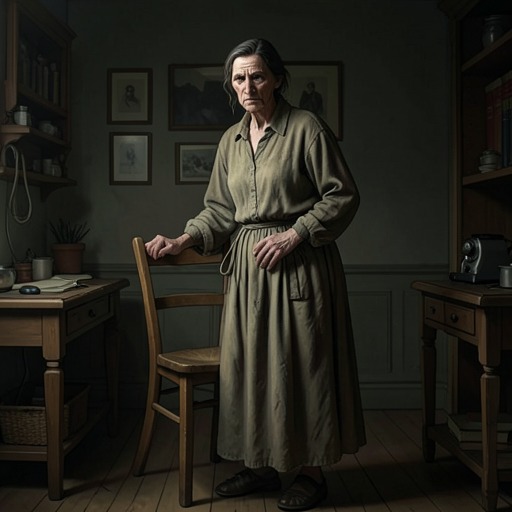
Madame Henrouille
Journey to the End of the NightMadame Henrouille, the surviving member of the Henrouille household, appears at the end of the narrator’s return through a neighborhood crowded with memories. He finds her living alone after the deaths in the family and pauses outside her door, but the encounter never takes place. His decision not to knock makes their separation definitive: he concludes that they have become strangers, divided by death and by the different depths of darkness into which life has carried them.
Return to the Henrouille House
The narrator knows the route to the house by heart. The green and red lights at the grade crossing still mark the way, and he remembers having visited often in earlier days. Yet familiarity does not bring him inside. Outside the door, he stops to think of Madame Henrouille alone, with the others dead, and wonders whether she knows or suspects how the old woman died in Toulouse.
The pause is given physical shape by the winter night. A street lamp whitens the glass top of the small portico over the doorstep; the narrator stands at the corner for a long time, freezing, with the bell within reach. He believes Madame Henrouille would have let him in, and notes that they had not quarreled. The obstacles are not practical or openly hostile. The visit fails because his desire to see her has suddenly disappeared.
A Friendship That Cannot Be Resumed
The narrator rejects fear as the reason for staying away. He tells himself that he has simply lost interest: there is nothing more Madame Henrouille could tell him, and listening to her would bore him. That abrupt judgment converts an unfinished visit into a final break. They had once understood each other and had been friends in their own way, but he now insists they are nothing to one another.
Death and life both stand between them. The narrator places himself farther into the night than Madame Henrouille and even farther than the dead Grandma Henrouille. His language makes separation less a dispute than a divergence in experience: they have left each other for good, and no conversation at the doorway could restore their former proximity. He mutters, “Each man for himself,” and turns back toward Vigny.
Education, Character, and Descent
As he walks away, the narrator explains the divide through education. Madame Henrouille, he thinks, does not have enough education to follow him further. He concedes that she has character, then treats that quality as insufficient: in his judgment, understanding the world’s viciousness requires both a heart and a certain amount of knowledge. Education becomes his measure of whether another person can keep pace with his increasingly bleak perception.
His assessment is also self-implicating. He calls Madame Henrouille vicious and stubborn, but he is the one who has decided that she cannot descend far enough to meet him. The narrator’s governing maxim is that life does not move upward but downward; he imagines himself as having gone lower than she can reach. The passage therefore presents his rejection both as a judgment of her limitations and as evidence of the isolation he has made into his own position.
Narrative Significance
The scene delays a simple reunion by lingering over the threshold: the familiar route, the lit crossing, the whitened portico, the cold, and the unpressed bell. The house is close enough to enter, and Madame Henrouille is not described as having barred him out. The decisive barrier is the narrator’s inward loss of desire, which turns ordinary details of return into signs that the past cannot be recovered.
Madame Henrouille is consequently defined here through absence as much as presence. She remains in the house, but the narrator leaves without seeing her, carrying away his conclusion that they have been separated by death, life, and unequal capacities for understanding. His return to Vigny closes the possibility of renewed contact in this encounter, while exposing the cost of his self-image as someone who has gone further into the night than those he leaves behind.